“Enrichments” was the name of a collection of spoken word audio features that played on the ‘music-of-your-life’ radio station CKLA-FM in Guelph, Ontario in 1989.
Interspersed with sweeping-string-muzak sounds, Enrichments offered listeners pieces by American broadcaster Paul Harvey in his now classic, The Rest of the Story; health reports by Doctor Henry Fishman; a feature about pets; and reports from the Financial Post about personal finance and business.
One ‘enriching’ report from the Financial Post told the story of a chef school, Istituto Alberghiero, in Villa Santa Maria, in the Abruzzo region of Italy, about three hours east of Rome, and a short drive to the Adriatic Sea.
FP reporter Eva Innis explained how the ‘village of 1800 had been producing outstanding chefs for four centuries’.
“Some 40 percent of the village’s total male working force are chefs or waiters, almost all working elsewhere,” said Innis.
“Many [are] cooking for or serving the rich, royal and powerful at homes and hotels in Italy and beyond. The late Emperor Hirohito of Japan had a chef from Villa Santa Maria, as did the Swedish Royal house, cartoon king Walt Disney and Giovanni Agnelli, head of Italy’s giant Fiat Motor Company.”
The people of Villa Santa Maria know the story of San Francesco, his family and the birth of what is called the “Home of the Cooks” very well.
‘You do it because you like cooking’
Chef Gino Marchetti of Toronto has fond memories of the cooking school in Villa Santa Maria which he attended in the 1960s.
“They train you to be proud of what you’re doing. It’s not that you do that for money or anything. You do it because you like cooking,” said Marchetti.
“You study the history of cooking, the history of a single dish that you prepare…and the ingredients. At the beginning you use the book but at the end you are not allowed to use the book anymore. It has to be in your head. You have to remember exactly what it’s all about.”
Marchetti said he continued to use a lot of the recipes he learned at the cooking school throughout his career.
“They didn’t have the equipment at the time [that I attended the school]. But they gave you the recipe and the chef would cook and show you the technique,” said Marchetti.
“[The instructor showed] how to set up a menu and buy things, the names of the parts of all the animals to make those [recipes]. They taught you the basics really. “
Things have changed at the school since Marchetti attended. He explained there are now a number of kitchens and better equipment since. Also, he noted, students come out with full chef credentials and as a result are not required to apprentice like he did in the 1960s.
Listen
Click on the play button in the box to hear the original 1989 audio of Eva Innis’ report on the cooking school at Villa Santa Maria, Italy. The transcript of the audio is below.
Each year an elite band of newly trained chefs steps out from a village deep in the Apennine Mountains to tickle palates around the world.
They are graduates of the state cookery school of Villa Santa Maria, a village of 1800 people that has been producing outstanding chefs for four centuries.
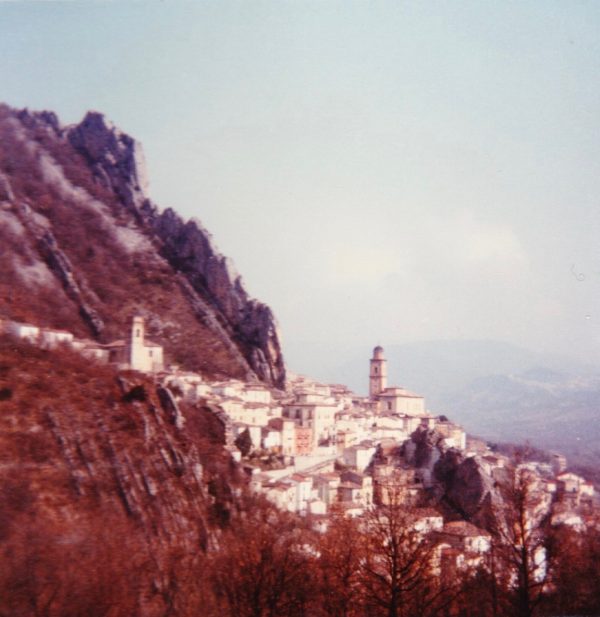
10 percent of the 120 members of the “Collegio Cocorum’ (spelling) the honour club of Italy’s foremost living chefs are from Villa Santa Maria, a village that clings to a rock face in the harsh isolated Abruzzi region of central Italy.
Some 40 percent of the villages total male working force are chefs or waiters, almost all working elsewhere. Many cooking for or serving the rich, royal and powerful at homes and hotels in Italy and beyond.
The late emperor Hirohito of Japan had a chef from Villa Santa Maria, as did the Swedish Royal house, cartoon king Walt Disney and Giovanni Anielli, head of Italy’s giant Fiat motor company.
The schools strength is its Italian cuisine with its wide regional variations. Although it also teaches other countries traditions.
One current pupil is Canadian and students and staff will spend a week in Moscow in April demonstrating their skills.
Why Villa Santa Maria should be such a chef’s paradise is shrouded in legend. But for centuries there has been little else to occupy man in an area of mountains and rocky soil that has fought a winning battle against cultivation.
People in the village date the tradition back to San Francesco Caraciolo the son of a local noble family born in 1563 who shunned the rich life for Catholic devotion. Other noble families would flock to the Caraciolo summer hunting retreat in Villa Santa Maria in the saints day not because of the hunting but because of the particularly tasty way the game was cooked by the servants.
The Italians Chef’s federation wants San Francesco to be made patron saint of cooks. His remains are to be taken out of the local church each October and carried through the streets in a glass coffin by the schools trainees in their chefs uniforms.
This is Eva Innis at the Financial Post
Reporters footnote
San Francesco Caraciolo was named the Patron Saint of Italian Cooks by the Pope in 1996.
Villa Santa Maria is also the birthplace of my mother and three older sisters. It is the largest town closest to the farm where my father and all of his chef brothers and one waiter were born.
My father left the farm he grew up on, on the advice of his father, who told him to learn a trade. More on that story can be heard in the two Episode 10s I have posted: Cooking for Frank Sinatra, both in English and Italian.
During a news shift, my job was to dub the audio stories from a reel-to-reel machine onto an audio cart and insert that cart into a high-tech piece of analog machinery, for the late 1980s, called ‘auto’ that would play those reports at specific times throughout the broadcast day on CKLA 106.1.
The voice at the beginning of the audio saying “119” is the audio editor at what was called Broadcast News at the time; now, Canadian Press. They would send audio to subscriber stations at certain times of the day.


 Station to Station with Joe Pavia
January 31, 2019 at 9:07 pm
Wonderfully done Joe .😎
LikeLike