
What began as just a quick trip to the Kitchener Public Library turned into a five year, independent research project about the former owners of the house my family and I lived in.
When my wife and I purchased our 1930s home, we discovered that 16 different families had lived in the house between 1932 and 1997.
The first question we had: what’s wrong with the place?
Well, nothing!
The families that lived here moved in an out for different reasons and in differing circumstances. Through my research I uncovered many great stories and some amazing photos of five of the 16 former owners.
This blog focuses on John and Florence Allan. They moved to Kitchener in the early 1920s after Jack, as he was referred to, accepted the job of managing the new Capitol Theatre. In 1932 he added the Lyric Theatre to his duties.
What you are about to read is a revised version of an article that was first published in the 2010 Waterloo Historical Society Annual Volume 98, and in a book I self-published.
A majority of the information about the Allans was provided by their daughter Kathy Bishop whom I interviewed in the early 2000s. A lot of other information, mostly about the changing movie theatre industry at the time, which was so interesting to read about came from newspaper articles and other published historical documents.
LISTEN to me read the blog here:
The beginning
The movie theatre business was somewhat of a safe haven during the financial depression of the 1930s in Canada. That’s because most people could afford a few cents to escape into a theatre for several hours.
Jack Allan of Kitchener was able to support his family comfortably during that time in his capacity as the manager of two popular theatres in Kitchener. It allowed Jack and Florence Allan to move into a newly built home with their two sons Matthew and John.
The house was on Simeon Street, in the expanding neighbourhood of the East Ward, and cost $5,000.
Florence
According to Kathy Bishop, her mother hated the City of Kitchener when she and her husband Jack first moved there. Florence Allan thought she had made a mistake moving to the predominantly German-speaking city that put her miles away from her family who were near Ottawa.
Flo, the outsider, encountered a new language and many friendship cliques which, at first, were slow to welcome her.
Florence Kavanaugh was born in 1900 in the eastern Ontario village of Cardinal, the oldest of 11 children of George and Edith Kavanaugh. Following high school, young people either left to live in a bigger city or went to work at the nearby Canada Starch Company, the oldest corn refining company in Canada.
Florence had more in mind than a factory job: she would make her passion for the piano her key to leaving. Edith Kavanaugh had taught Florence and her ten siblings to play piano from a young age. Florence had become a sufficiently talented pianist that she knew this would be her ticket out of Cardinal.
In 1918, at the age of 18, Florence moved to Toronto where she studied at the Ontario Conservatory of Music. The professional music schooling built upon what she had learned from her mother. Florence was on her own in Toronto, working at an insurance company by day and studying piano at night.
Jack
Around the time Florence was studying in Toronto, John Allan was heading home to Montreal from two years of overseas military duty in the First World War.
When he enlisted John had been living in Montreal with his mother Maud in the Brighton Apartments on Mayor Street. His military attestation papers indicate he was a salesman before signing up.
The military attestation papers paint a picture of John Henderson Allan. In 1916, he was 23 years old, 5 feet 9 inches tall, had a medium complexion with grey eyes and dark brown hair.
The medical officer on duty considered John Allan fit for the Canadian Overseas Expeditionary Forces. The document was witnessed and signed by the magistrate present and John Allan was off to war.
I don’t know what action he actually saw but John spent two years with the Duchess of Connaught’s Own Irish Canadian Rangers.
When he returned home, John found employment in Montreal with a film distribution company known as Canadian Exhibitors. Jack’s work brought him to Toronto.
Through a mutual friend John and Florence met, fell in love, courted and were married.
The wedding was held on May 20, 1920 at the Roman Catholic church in Cardinal, Ontario. Florence was 20, John (now Jack) was 28.
After honeymooning in Quebec, they began their life together, briefly in Toronto, before Jack’s work brought the couple to Kitchener.
Movie theatres
The 1920s saw many changes in the movie industry with the introduction of larger and more luxurious theatres in Canada and the U.S that offered live performances along with movies.
So-called “new tradition” movie palaces were being built in New York City where the Capitol had opened in 1919 with 5,300 seats. In Toronto the Pantages theatre and Loew’s Uptown were opened; and Hollywood boasted the Grauman’s Egyptian and Chinese Theatres.
These palatial and exotic theatres were mirrored in a smaller scale in Kitchener, population 21,000.
Jack Allan was hired as a manager at the newly opened Capitol Theatre, the first of two grand movie houses being built in the city in 1921 at a cost of $250,000.
A newspaper article from that time described the large stage and the four dressing rooms that would accommodate future acts, primarily vaudevillians and community dramatic and musical groups.
The theatre seated 1,200 people with a few box seats near the stage that could accommodate another 18 moviegoers.

Opening night
The box office opened the day before opening night so customers could buy their tickets in advance for the 8:00 p.m. show.
The price for the opening night, and future evenings, was 35 cents for an adult and 25 cents for children. Matinee prices were lower: 25 cents for adults and 11 cents for children.
Opening night at the Capitol Theatre on April 4,1921 began with a concert performed by the Capitol Concert Orchestra; this was followed by newsreels, travel films, a serial, a comedy and the feature film called Behold My Wife.
Kitchener’s movie theatre boom continued in 1921. One month after the 1,200-seat Capitol opened, the second modern movie house made its debut just a few doors west. The Lyric surpassed the Capitol as the city’s largest cinema by 200 seats.
Jack and Florence at work
One of Jack Allan’s duties at the Capitol was to promote the theatre and its movies and provide local newspapers with previews of movies that would be playing that week.
On May 16, 1923 The Young Diana starring Marion Davies ended its run and was replaced by Charlie Chaplin’s latest film The Pilgrim.
Jack wrote in the Kitchener Daily Record of that date: “The one and only Charlie Chaplin is coming to the Capitol tomorrow in his latest riot The Pilgrim.” Allan described how Chaplin’s “tricks are mostly new ones and guaranteed to get even a laugh out of a brass monkey.”
Kathy Bishop recalled one story of a theatre promotion her mother was involved with.
As Kathy told it, the Capitol hired Canadian First World War flying ace Billy Bishop to fly over King Street while a passenger dropped flyers promoting the special movie. Jack Allan was supposed to be that passenger.
Just as he was about to get into the plane he got too nervous; instead Florence went up.
“She was so terrified in the air with Bishop that she couldn’t look down, “ recalled Bishop.“Mom said…’after making fun of Jack, I got up there and couldn’t throw the flyers.”
Billy Bishop did another pass and signalled the right moment to toss the flyers from the plane.
By 1927, sound arrived at the movies. But moviegoers at the Capitol would not hear the world from the big screen until February 1929.
All-Talking Pictures
On February 2, the Kitchener Daily Record’s headline revealed that talkies were coming to the Capitol.
New technology meant new prices: to see Interference, the first talking picture at the Capitol, adults had to pay 50 cents for the evening performance, or 35 cents for matinees.

1937
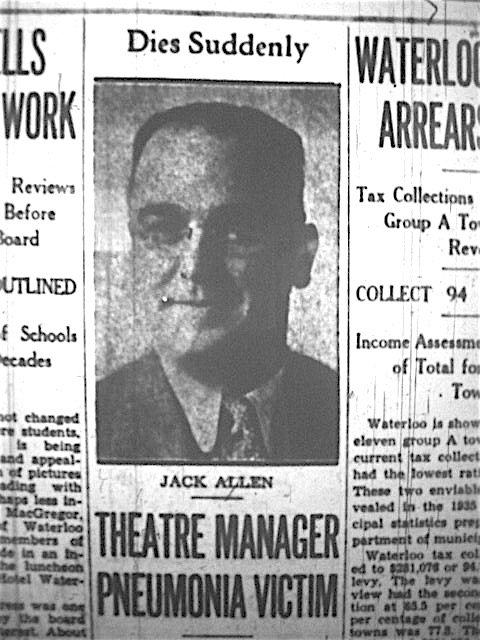
The news of Jack Allan’s death was published on the front page of the Kitchener Daily Record newspaper on April 9, 1937.
The paper reported that Jack died in Hamilton following “an attack of pneumonia”. He was 45.
“Five years ago, Mr. Allen became manager of the Lyric Theatre. In addition to a commendable record with the company by whom he was employed, Mr. Allen enjoyed as well an excellent war record. He went overseas in 1914 with the Irish Rangers, Montreal and saw much action. Following the war, from 1918 to 1920, he was associated with Canadian Exhibitors in Montreal until he came to Kitchener.” (Kitchener Daily Record)
Allen was survived by his wife Florence, his three children Matthew, 12, John, 8 and Katherine 1.
In the 1938 Vernon’s Directory, Florence Allan is listed as the widow of John Allan. She was now a single mother at the age of 37.
Changes
Changes were felt by the children as well as their mother who returned to the work force.
The first change to come was to sell the house. It was a difficult thing to do, remembered Kathy Bishop.
“She loved the place and said it broke her heart to leave Simeon Street,” said Kathy.
“The friends she had made since moving into Kitchener she never saw anymore because she was working. When she came home at night she was tired.”
Matt Allan was at the impressionable age of 12 and Kathy Bishop said he was the most deeply affected of the children when his father died.
“He went from living a life where money was no object for reasonable things,” said Bishop.
“Money was an object when mom was working on her own to support the family. He hated leaving Simeon Street. He always talked about it years later and would visit the house when he came back to visit.”
Florence and her children moved to an apartment on Queen Street South in Kitchener.
She was able to find work as a secretary at Doon Twines in Kitchener, a company which made rope and twine. It was owned by Henry and Mabel Krug, who were friends of Jack and Florence. She would work there until she retired in 1965 at the age of 65. Florence Allan passed away in 1976.
Matt left home at the age of 18 in 1943 to become a merchant seaman. His sister Kathy said he kept in contact with the family via postcards from his worldwide ports of call.
He eventually took up residence in Australia where he passed away at the age of 69 in 1994. A service took place at sea; his ashes were scattered from the deck of one of the ships on which he had served.
John, the second-born son, operated a Kitchener paint store called Colour Bar in the mid-1950s then entered a life in sales, working for an ink company in Toronto. He spent time working in British Columbia before moving back to Ontario. John passed away in 1992, at the age of 63.
Kathy, whom I interviewed for this article, lived in Kitchener and worked at CKCO television. She died in the mid-2000s.


 Station to Station with Joe Pavia
Leave a comment